Here’s a number that should stop you mid-scroll: according to Ahrefs’ analysis of 2 million randomly sampled pages, 95% of newly published content never reaches Google’s top 10 within its first year. Not “ranks poorly.” Never gets there at all. If you’ve been chasing SEO Google ranking results and feel stuck, you’re not alone, and you’re probably closer than you think.
So when a website actually breaks through that wall, and manages to rank on Google in a matter of weeks, not years, it’s worth paying attention to exactly how. I came across a real case study shared on Reddit’s r/Agentic_SEO recently that shows precisely this kind of curve, and it lines up with a pattern we see constantly in our own client case studies at The Fixer Marketing. Let’s break down what actually happened.
The SEO Google Ranking Numbers Behind This Case Study
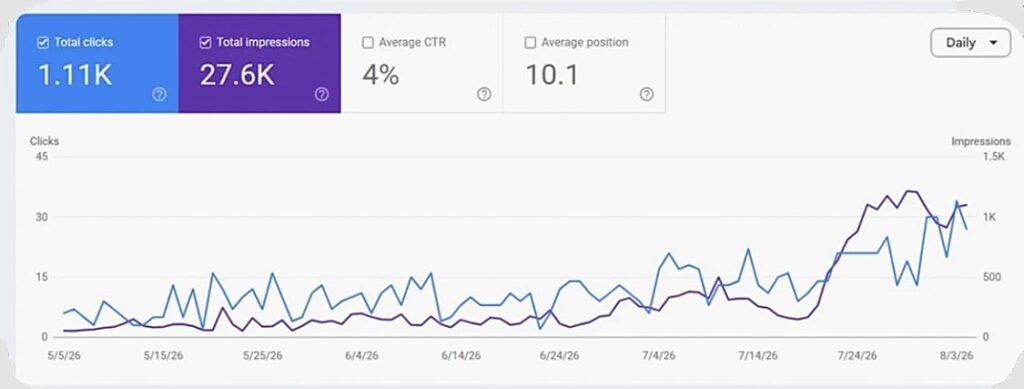
The case study, shared by the site owner of an app installation platform, showed the following Search Console data over roughly a three-month window, from early May 2026 to early August 2026:
- Total clicks: 1.11K (up from effectively zero)
- Total impressions: 27.6K
- Average CTR: 4%
- Average position: 10.1
Look at the shape of that growth, not just the endpoint. For the first six to seven weeks, the graph is basically flat. Clicks bouncing between 0 and 15 a day. Impressions barely moving. Then, right around late July, both lines bend sharply upward and keep climbing. That inflection point isn’t random, and it isn’t luck either. It’s what SEO actually looks like when it’s working.
Why Most Sites Never Rank on Google
This is the part that connects directly back to that 95% Ahrefs stat. Most sites don’t fail at SEO because their content is bad. They fail because they quit during the flat part of the graph, the first six to eight weeks, before the curve ever has a chance to bend.
This lines up with what most current SEO research shows. Semrush’s own State of Search reporting consistently finds that newly created pages typically take 3 to 6 months to generate meaningful impressions, and 6 to 12 months to reach page-one positions for genuinely competitive keywords. Ahrefs’ data adds another layer to this: even among the small percentage of pages that do eventually rank in the top 10, the average top-10 result is over 2 years old. Authority compounds. It doesn’t arrive on day one. Google’s own SEO Starter Guide makes a similar point directly: there’s no shortcut that instantly ranks a site first, only the steady, foundational work of making a site easier for search engines to crawl, index, and understand.
So the businesses that quit in month two aren’t necessarily doing bad SEO. They’re often doing fine SEO and stopping right before the payoff shows up in the data.
What the Case Study Actually Did Differently
According to the original post, the site owner focused on five specific things, none of which are flashy, all of which are foundational:
Solving technical SEO issues before scaling content. Not writing more, fixing what’s broken first. Crawl errors, slow load times, and indexing problems all quietly cap how much a new page can grow, no matter how good the writing is. This is usually the very first thing we check in a free SEO audit at The Fixer Marketing, before touching a single word of content.
Targeting keywords based on user intent, not just search volume. Chasing the highest-volume keyword in your space often means competing against pages with years of authority behind them. Targeting what someone actually wants when they type a phrase tends to convert better and rank faster.
Building topical authority around core features. Instead of scattering content across unrelated topics, the strategy concentrated coverage around the platform’s actual core functions, giving Google a clearer signal about what the site is actually an authority on.
Strengthening internal linking and earning quality backlinks. Internal links help Google understand your site’s structure and pass authority between pages. External backlinks remain, even in 2026, one of the strongest trust signals Google uses.
Why Checking Google Ranking Weekly Mattered Here
Tracking Search Console weekly and optimizing pages already gaining impressions. Rather than spreading effort evenly, the strategy doubled down on pages already showing early signs of traction, since those are the pages closest to breaking through. Checking Google ranking data weekly, instead of once a month or only when something feels off, is what let this site catch that inflection point early and lean into it.
What This Means If You’re Staring at a Flat Graph Right Now
If you’re a few weeks or even a couple months into an SEO effort and the numbers still look flat, this case study is a useful gut-check, not because it guarantees the same outcome, every site and niche is different, but because it shows the shape growth actually takes when the fundamentals are solid.
A flat graph in week six doesn’t necessarily mean something’s wrong. It might just mean you’re not at the bend yet. The real question isn’t “why isn’t this working,” it’s “are the fundamentals actually in place for when it does.”
That’s exactly the kind of diagnostic work we run in a free audit at The Fixer Marketing, checking whether the technical foundation, keyword targeting, and topical structure are set up to eventually produce this curve, or whether something underneath is quietly capping the growth before it ever gets the chance. If you want to see what that looks like for your own site, our SEO services page walks through exactly how we approach it.
Frequently Asked Questions
Most established websites begin seeing measurable organic growth within 3 to 6 months, according to Semrush’s State of Search research, while highly competitive industries or brand-new websites can take 6 to 12 months or longer.
Ahrefs’ analysis of 2 million pages found that 95% of newly published content never reaches the top 10 within its first year, largely because ranking on Google requires strong backlink profiles, topical authority, and technical health, all of which take sustained time to build.
Yes. A flat growth curve in the early weeks is a common pattern, not necessarily a sign of failure, particularly when technical SEO, intent-based keyword targeting, and internal linking are already in place and simply need time to accumulate trust signals with search engines.
Start with technical SEO health (crawl errors, page speed, indexing), then review whether keywords are matched to real user intent, and whether your content is building topical authority around a clear core focus rather than scattered topics.
Sources
- Case study shared on Reddit, r/Agentic_SEO
- Ahrefs, analysis of 2 million pages, cited via FactoryJet SEO Timeline Report, 2026
- Semrush, State of Search research, cited via the same report above
- Google Search Central, SEO Starter Guide