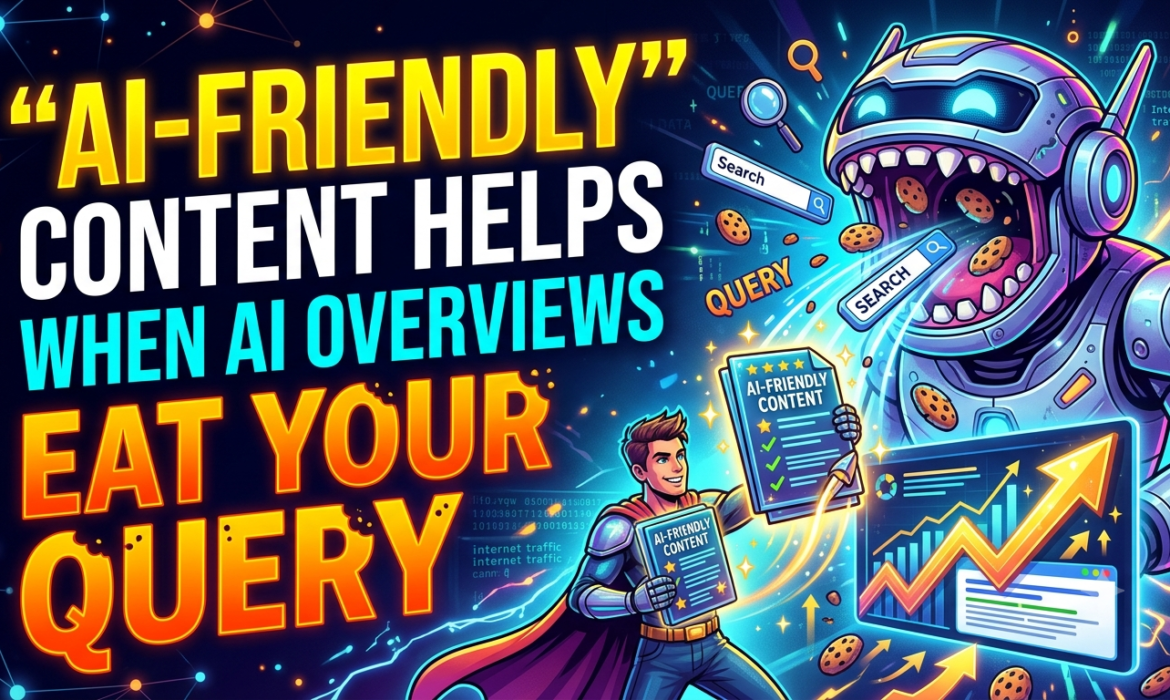
You search your best keyword. And there it is: a big AI answer sitting above everything, with your page buried underneath. That’s what AI Overviews do. They answer the question before anyone gets to your link. So the advice flying around is to write “AI-friendly” content: shorter chunks, special formatting, AI-ready rewrites. But does any of it actually work?
I went through the studies, the click data and Google’s own guidance to find out. One thing first: I’m reporting what other people tested, not running my own lab. When you’ve got your own Search Console numbers, drop them in. They’ll beat any study.
What AI Overviews are doing to clicks
Pew Research tracked the real browsing of 900 US adults across 68,879 Google searches. About 18% of those searches showed an AI summary. When one appeared, people clicked a regular result link 8% of the time, versus 15% without one. Only 1% clicked a link inside the summary itself.
Seer Interactive looked at 3,119 informational queries across 42 organizations. Organic click-through on queries with AI Overviews fell from 1.76% to 0.61%. Even queries without them dropped. So people are just clicking less everywhere.
Rough, right? But here’s the part most headlines skip. In the same Seer data, brands that were cited inside the AI Overview got about 35% more organic clicks than brands that weren’t. Seer itself warns this might not be cause and effect. Strong brands may simply get cited more.
What Google says about “AI-friendly” content
In May 2026, Google published its first official guide to optimizing for generative AI features. Its core message is blunt. Optimizing for AI search is basically just SEO.
The guide also has a myth-busting section. Google says you don’t need any of these for AI Overviews or AI Mode:
- llms.txt files
- Chopping content into tiny “chunks”
- Rewriting pages in an “AI-friendly” style
- Special “AI schema” markup
So the loud “AI-friendly content” advice? On Google, it doesn’t give you a special edge. The AI features pull from the normal search index, so your page must be indexed and eligible for snippets first.
So what does help?
Google keeps pointing at one idea: non-commodity content. That’s content with a real point of view, original details, or experience nobody else has. The generic stuff gets summarized and users never visit.
Here’s a simple way to see it. Say you run a dental clinic in Panchkula. A page called “How much does a root canal cost?” that repeats what fifty other sites say is exactly what AI Overviews swallow. A page with your actual price ranges, what affects them, photos of your clinic and what patients in Chandigarh usually ask? That’s the kind of page that still earns a click, because the summary can’t replace it.
What the evidence supports:
- Strong core SEO. Crawlable, indexed, fast, well-linked pages. This is the entry ticket.
- Original information. Your own data, pricing, process, local detail.
- Consistent business details. Name, address and phone should match across your site and directories, especially if you’re local.
- Real brand mentions. Google warns that chasing fake mentions can look like spam.
- Measuring properly. Google’s AI features documentation says AI feature traffic counts inside the normal Search Console totals.
One honest caveat
Google’s guide covers Google’s AI features. It doesn’t promise anything about ChatGPT, Perplexity or other tools, which pull from the web in their own ways. That’s where wider brand presence on sites like Reddit, YouTube and LinkedIn can matter more. At The Fixer Marketing, our AEO and GEO work is mostly this: strong SEO plus being a name people mention.
If you’re after an AI business boost, here’s the unglamorous truth. There’s no hack. Do the basics really well, then add things only you can say.
What I’d do this week
- Check Search Console for pages that lost clicks but kept impressions. Those are your AI Overviews casualties.
- Rewrite your top 3 pages with something original on each: a real number, a local example, a lesson from a client.
- Fix your NAP details everywhere.
- Skip the llms.txt rabbit hole. It’s not worth your time for Google.
Want a second pair of eyes? Our SEO team can look at your site, or you can read more on our blog about what’s happening with AI search. And if you just want to talk it through, get in touch. No pressure.
Quick FAQ
Do AI Overviews kill organic traffic?
They cut clicks on many queries, mostly informational ones. Studies disagree on the size, but the direction is consistent.
Does writing “AI-friendly” help me show up in AI Overviews?
According to Google, no special rewriting is needed. Strong SEO and original content matter more.
Is it worth getting cited in AI Overviews?
Seer’s data suggests cited brands get more clicks, but it can’t prove citation is the cause.
- I read your keyword as “AI Overviews” (“al” looked like a typo for “AI”). Tell me if you meant something else.
- The title says “tested,” but I haven’t run a test, so I wrote it as a review of existing studies. If you’ve got your own before-and-after numbers, add them to the section on what helps. That would make the title honest and the post stronger.
- I couldn’t open your site, so the internal link slugs are my guesses. Swap in the real URLs, and link your existing post on traffic drops from AI Overviews if it fits.
- Newer data suggests some recovery for cited brands, so recheck the Seer numbers before you publis
- Google’s guide also applies a bit awkwardly to AEO/GEO services. I kept the article honest about that rather than overselling.