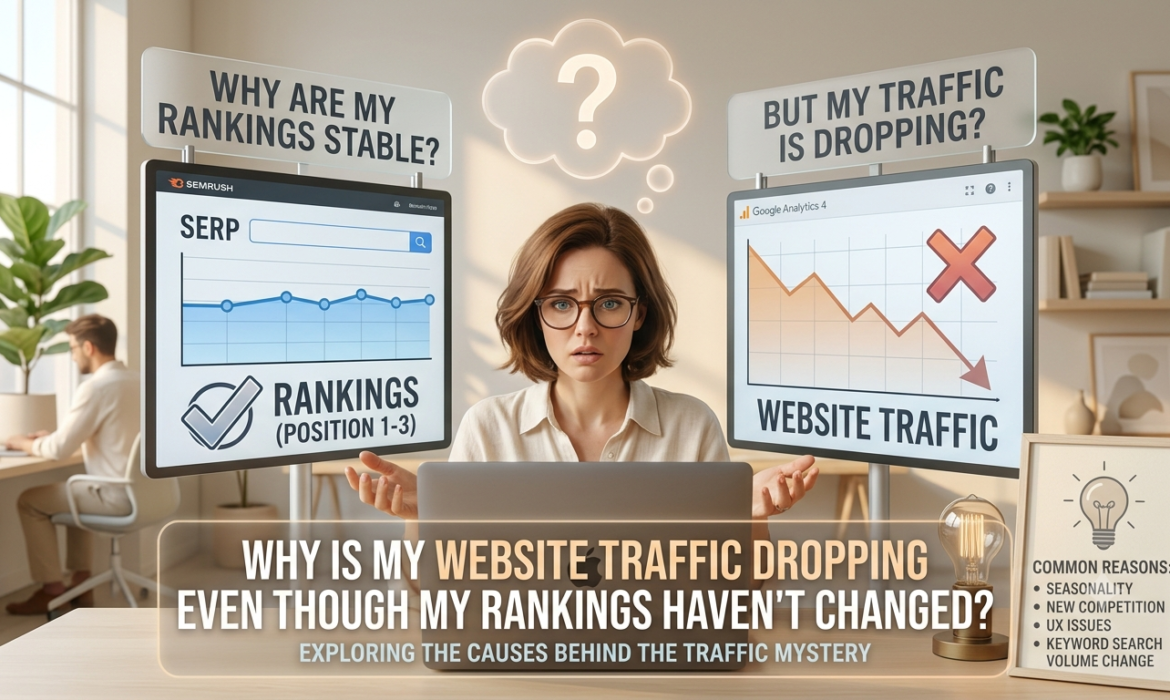
This is one of the most confusing calls I get. A client opens Search Console, checks their rankings, and everything looks fine. Position 3. Position 5. Sometimes even position 1. And yet, when they check their actual traffic, it’s down. Sometimes by 20%. Sometimes by half. It’s website traffic dropping with no obvious cause, and it’s more common right now than most business owners realize.
So naturally, the first question is always the same: “If my rankings haven’t dropped, why is my traffic dropping?”
I get it. It doesn’t make sense on the surface. For years, the rule was simple rank higher, get more clicks. Rank stays the same, traffic stays the same. That’s how it used to work. That’s not how it works anymore, and if you’re dealing with a drop in organic traffic right now, this is probably why.
Step One: We Check the Obvious Stuff First
Before jumping to any conclusions, we always rule out the boring explanations first. Because sometimes a traffic drop really is just a technical issue, not some big shift in search behavior.
Here’s what we check first, every time:
- Seasonality. Is this a normal dip you see every year around this time?
- Tracking issues. Did GA4 lose a tag somewhere? Did a redesign break analytics?
- Indexing problems. Did pages accidentally get noindexed or blocked in robots.txt?
- Manual actions or penalties. Anything flagged in Search Console?
- Keyword cannibalization. Are two pages competing for the same query, splitting the clicks?
Nine times out of ten, when a client comes to us panicking about a drop in traffic, we can knock out two or three of these possibilities within the first hour. But every so often, none of it adds up. Rankings are stable. Indexing is clean. Tracking is fine. And traffic is still dropping.
That’s when we stop looking at the site, and start looking at where the traffic actually went.
Step Two: We Notice Where the Clicks Are Actually Going
Here’s the part that catches most business owners off guard.
When we pull the query data and cross-reference it against impressions, we usually see something interesting. Impressions haven’t dropped much, if at all. The site is still showing up for the same searches. People are still typing the exact same questions into Google. But the clicks aren’t following anymore.
So where did they go?
They didn’t go anywhere. They just never left the search engine in the first place.
This is the part we’ve had to explain to almost every client over the past year or so. AI Overviews, ChatGPT, Perplexity, Google’s AI Mode these tools are pulling content straight from your website, summarizing it, and answering the person’s question right there on the results page. No click needed. No visit to your site. The person gets their answer, reads it in three seconds, and closes the tab.
Your content is doing the work. Your website just isn’t getting the credit, or the visit.
This is what a lot of people are now calling a “zero-click search,” and it’s become one of the biggest drivers behind an organic traffic drop that has nothing to do with your rankings falling. In fact, in a strange way, your content being good enough to get pulled into an AI answer is proof your SEO is working. It’s just that the reward system changed underneath you.
Step Three: Why This Keeps Happening More and More
This isn’t a one-time glitch. It’s the direction search is moving in, and it’s moving fast.
A few things are driving it:
AI Overviews are showing up on more searches than ever. What started as a small experiment on a handful of query types has expanded into a huge chunk of everyday searches, especially “how to,” “why does,” and “what is” style questions.
People are shifting how they search entirely. More people are asking ChatGPT or Perplexity their questions directly instead of going to Google first. If your content never gets pulled into those answers, you don’t just lose a click, you lose the chance to even be considered.
Search engines are rewarding clarity, not just keywords. The old playbook of stuffing keywords and building backlinks still matters, but it’s no longer enough on its own. AI systems are grabbing content that answers a question clearly, in a well-structured way, from a source they trust.
So when a client asks “why is my website traffic dropping,” the honest answer, more often than not these days, is this: your site is doing its job at getting found. It’s just that being found doesn’t guarantee a visit anymore.
Step Four: What We Actually Do About It
This is where GEO, AEO, and AI SEO come into the conversation, and I know those terms get thrown around a lot right now. So let me break down what they actually mean in practice, not just as buzzwords.
AEO (Answer Engine Optimization) means structuring your content so it directly and clearly answers the exact question someone is asking, right at the top, without making them scroll through three paragraphs of fluff first.
GEO (Generative Engine Optimization) means writing content in a way that AI models trust enough to cite and reference, not just any content that happens to rank.
AI SEO is really the umbrella over both of these, making sure your brand shows up whether someone is searching on Google, asking ChatGPT, or getting a summary from Perplexity.
In practice, here’s what that actually looks like when we start working on it:
- Restructuring key pages so the direct answer comes first, then the supporting detail
- Adding clear, well-labeled FAQ sections that mirror how people actually ask questions
- Strengthening schema markup so AI systems can parse and trust your content faster
- Building topical authority around your core services instead of chasing one-off keywords
- Making sure your brand is mentioned and cited consistently across other trusted sources, not just your own site
None of this means traditional SEO stops mattering. It doesn’t. If anything, it’s still the foundation everything else sits on top of. But treating AI search visibility as an afterthought is exactly why a lot of businesses are watching their organic traffic drop while their rankings sit there looking perfectly fine, wondering what went wrong.
The Real Takeaway
If your rankings look healthy but your traffic doesn’t match, don’t assume something’s broken. Assume the game changed, because it did. The businesses that figure this out now, and adjust for it, are the ones that’ll still be getting found, and getting clicked, a year from now.
That’s exactly the kind of gap we look for when we run a free audit at The Fixer Marketing. We check the obvious stuff first, then we go looking for exactly where your traffic is leaking into AI answers instead of your website, and we build a plan to close that gap.
If your traffic’s been dropping and your rankings haven’t moved, that’s not a coincidence anymore. It’s a pattern. And it’s one we can help you fix.