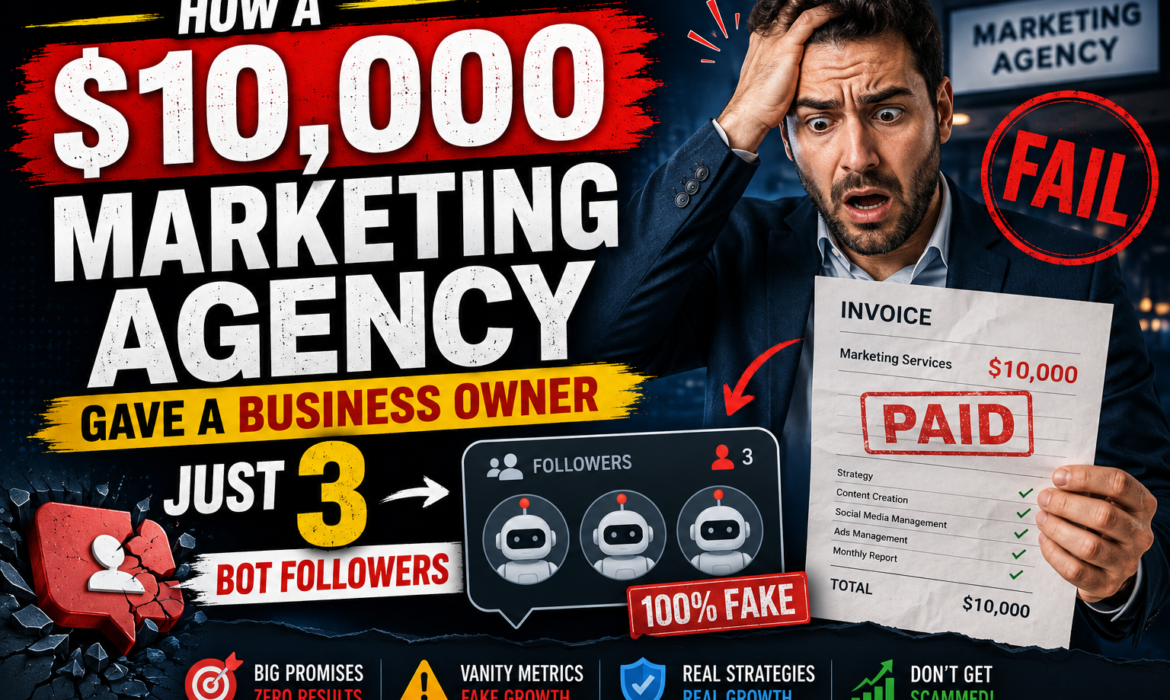
I came across a story on Reddit a few days ago that I haven’t been able to stop thinking about. A business owner posted in r/InstagramMarketing about paying a marketing agency $10,000, that’s somewhere around ₹8.3 lakh at current exchange rates, over three months. The result? Three followers. Bots, not real people. Zero sales the entire time.
I want to walk through what actually happened in that story, because it’s not some rare, freak outcome. It’s a pattern. And if you’re a business owner even slightly nervous about handing your marketing budget to a marketing agency, this is worth ten minutes of your time.
What Actually Happened
According to the original post, the business owner interviewed seven or eight different marketing agencies before choosing one. Not a rushed decision. She did her homework, got recommendations from two people she trusted, and the agency even showed her another creator in her niche whose account they claimed to have “blown up.”
She was making content consistently for two years already, with professional equipment, decent camera presence, and strong lighting. Not a beginner starting from zero. She handed the reins to the “experts,” even when she personally disagreed with the direction the marketing agency was taking her content.
Over the following months, she says the agency delivered daily B-roll footage, one piece of the scope of work, but never delivered the email funnels, sales page review, or the rest of what was promised in writing. When she pushed for updates, requests were reportedly avoided. When she eventually asked for a refund, she says the agency threatened legal action instead.
Three months. $10,000. Three followers, all bots. Zero sales.
Why This Isn’t a Freak Story
It’s tempting to read that and think, “well, she just picked the wrong agency.” But the fake follower and engagement problem behind stories like this is bigger and better documented than most people realize.
A 2026 fraud study by SociaVault Labs, which analyzed 100,000 Instagram and TikTok accounts using a 12-indicator fraud detection method, found that 37.2% of accounts showed meaningful signs of inauthentic followers or engagement. That’s more than one in three accounts across the industry carrying some level of fake activity, whether it’s the account being marketed to you as “proof,” or the growth being sold to you as a service.
There’s also a regulatory angle worth knowing about. In the United States, the FTC’s Consumer Reviews and Testimonials Rule, active since October 2024, makes it illegal to buy, sell, or generate fake social proof, including bot followers, where it misrepresents real influence. Violations can carry civil penalties exceeding $50,000 each, and the FTC moved from warnings into active enforcement through 2025. It’s a sign of how seriously fake engagement is now being treated, not just as a bad look, but as something regulators are actively cracking down on.
None of this excuses what happened in the Reddit story. But it does explain why it keeps happening. Fake growth is disturbingly easy to manufacture, and hard for a business owner to catch until the invoice is already paid.
The Red Flags, Looking Back
A few things stand out reading through her account of it:
“We blew up an account just like yours.” A single example, shown once, in a sales conversation, isn’t proof. Ask for multiple case studies, with actual numbers you can verify independently, not screenshots handed to you mid-pitch.
Vague reassurance instead of straight answers. She says she repeatedly raised concerns about the content style and was told, essentially, “trust us, we know your niche.” A real agency backs that claim up with a documented strategy, not just repeated reassurance.
Scope of work only partially delivered. B-roll got done. Funnels, email sequences, and landing page support reportedly didn’t. If deliverables aren’t tracked against a written scope of work with dates, it’s very easy for an agency to quietly drop half the promised work.
Defensiveness instead of accountability when questioned. Legitimate agencies respond to a refund request with a conversation. Threatening legal action in response to a client asking where their money went is, on its own, a significant red flag.
What This Should Actually Change About How You Hire
If you’re evaluating a marketing agency right now, a few practical things come out of this story:
- Ask to see growth reported in real engagement, not just follower count. A 5,000-follower account with 3% engagement is worth more than a 50,000-follower account with 0.3%.
- Get every deliverable in writing, with dates attached, not just a general description of “what’s included.”
- Ask how they measure success, and insist the answer includes sales or leads, not just impressions or follower growth.
- Be wary of any agency that discourages questions or gets defensive when you ask for updates.
This is genuinely the same standard we hold ourselves to at The Fixer Marketing. We’d rather show a client real numbers, even when they’re not glamorous yet, than inflate a report that falls apart the moment someone actually checks it.
Frequently Asked Questions
How common are bot followers and fake engagement in social media marketing? A 2026 SociaVault Labs study analyzing 100,000 accounts found that 37.2% showed meaningful signs of inauthentic followers or engagement, indicating the problem affects a significant share of the industry, not just isolated cases.
Is buying or generating fake followers illegal? In the United States, yes. The FTC’s Consumer Reviews and Testimonials Rule, in effect since October 2024, prohibits misrepresenting commercial influence through fake followers, views, or engagement, with civil penalties that can exceed $50,000 per violation.
What should be in a marketing agency’s scope of work? Every deliverable should be listed individually with expected timelines, not bundled into vague categories like “growth strategy.” If funnels, email sequences, or landing pages are promised, each should appear as its own line item you can check off.
How do I know if my agency’s growth results are real? Ask for engagement rate, not just follower count, and cross-check reported growth against your own account insights directly, rather than relying solely on the agency’s reporting.